'The hottest skill on Wall Street’: Demand for this AI ability jumped 1,721% as banks embrace agents

Before artificial intelligence can take Wall Street jobs, it is first creating them.
Posts for AI-related roles at banks including JPMorgan Chase, Citigroup and Capital One surged 49% this year compared with 2025 to 139,819 listings, according to an analysis by enterprise hiring data firm Draup that was provided exclusively to CNBC.
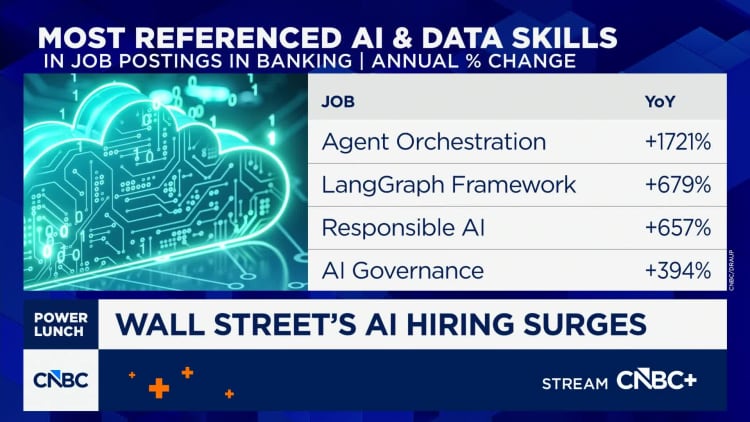
The fastest-growing area is a cluster of skills involving AI agents, according to Draup, which culls data from public job posts and platforms including LinkedIn. For instance, references to agent orchestration, or the ability to design agents that work in concert on a task, jumped 1,721% this year.
“This is arguably the hottest skill on Wall Street,” Draup CEO Vijay Swaminathan said in an interview. “It’s a massive opportunity. They need people who understand data and people who understand AI and where to put it.”
The job listings show that Wall Street banks are moving beyond chatbots to the next phase of their AI strategy, one that has implications for executives, employees and shareholders. To make good on AI’s promise to boost productivity and automate repetitive tasks, banks are pressing forward into a future filled with armies of agents handling an increasing share of labor.
While an earlier wave of AI hiring was dominated by engineers and data scientists building models or adapting them to corporate data, the boom has expanded to include people who are responsible for embedding AI directly into business lines.
Deploying AI inside a financial institution often requires stringing together multiple specialized agents: one to inspect raw data, another to analyze a document and a third to check regulatory compliance, for example.
The workers involved in this process, often called forward-deployed engineers, need a combination of technical abilities and domain knowledge of a specific business or function, from trading desks to back-office operations and human resources, according to Swaminathan.
“There is a lot of complexity in an enterprise,” Swaminathan said. “Sometimes these complexities are visible, but many times they are hidden. It takes a long time even to automate a simple process.”
For instance, creating a team of agents to automate approval of employee vacation requests creates a web of edge cases and specific exemptions, he said.
The agent orchestration skill is especially relevant to forward-deployed engineers, because their job is to figure out which agents are needed, what each one does and which technology to use, said the Draup CEO. It also involves deciding when human overseers need to be involved, he said.
Agent tech stack
Other in-demand skills related to the AI build-out involve understanding tools and techniques that give agents the ability to get things done.
References to LangGraph, a framework for building multistep workflows, jumped 679%, while mentions of LlamaIndex, which helps connect AI applications to data, rose 291%, according to Draup’s analysis. References to retrieval-augmented generation, or RAG, a technique for feeding AI models information from company databases, climbed 259%.
Beyond technical abilities, though, there is a growing emphasis on so-called soft skills.
“Our analysis shows that there is a renewed focus on soft skills like problem solving, creativity, ability to ask tough questions, being assertive [when it comes to] deeper understanding of the processes,” he said.
Other growth areas within AI include those responsible for creating guardrails around the emerging systems, including demand for risk and control infrastructure.
References in job posts tied to “responsible AI” surged 657% this year, according to Draup, while those mentioning AI governance and risk management jumped 394% and 359%, respectively. Security teams are also focused on preventing third-party tools or external model connections from creating systemic vulnerabilities.
Governance-related skills now account for more than 16,000 references in the Draup data, nearly twice the roughly 8,400 tied to training, deploying and running models.
“There is a lot of focus on making sure that the third parties that we are using in these products are not going rogue from a cybersecurity standpoint,” he said.
Roles tied to generative AI and agents typically pay more than tech roles elsewhere in finance, with generative AI managers paid a median base salary of about $190,000, according to Draup.
Despite the higher pay, filling these specialized roles remains a challenge, said Swaminathan.
To bridge the gap, major banks are leaning heavily into internal reskilling programs to train existing developers and domain experts, he said.
The build-out will itself create ripple effects: JPMorgan CEO Jamie Dimon has spoken of “huge redeployment plans” as AI takes over more work.
“I think the more we prioritize those soft skills with the right amount of technical skills, people will adapt and learn,” Swaminathan said. “It’s a very exciting time for the right talent.”

Choose CNBC as your preferred source on Google and never miss a moment from the most trusted name in business news.